
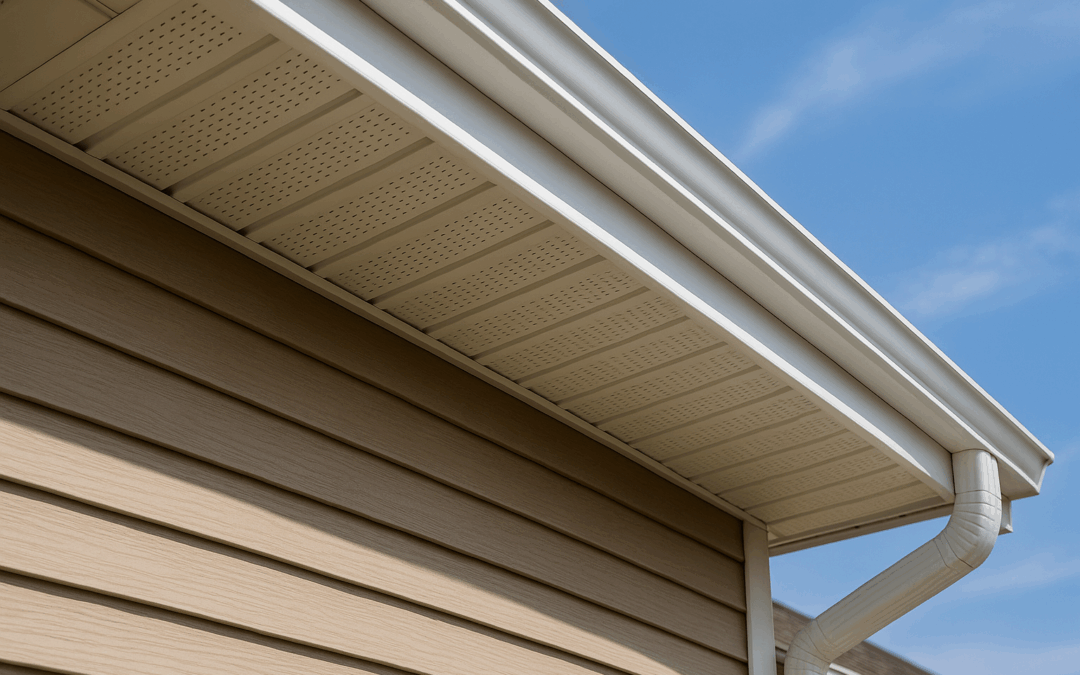
For Memphis, Tennessee homeowners evaluating exterior upgrades or replacing deteriorated roofline materials, vinyl soffit has become one of the most widely discussed options for enclosing the underside of roof overhangs. Positioned beneath the eaves between the exterior wall and the fascia board, soffit plays a critical role in attic ventilation, pest exclusion, and the finished visual appearance of the roofline. When that soffit is constructed from vinyl rather than wood, it brings a distinct set of performance characteristics that are particularly relevant in Memphis’s demanding humid subtropical climate. Tiger Gutters recognizes that Memphis-area homeowners benefit from a thorough understanding of vinyl soffit—what it is, how it is installed, what advantages it offers compared to traditional wood soffit, and what considerations matter when evaluating it for a Memphis home.
What Vinyl Soffit Is
Vinyl soffit is a soffit product manufactured from polyvinyl chloride (PVC)—the same broad family of plastic material used in vinyl siding, vinyl windows, and a wide range of exterior building products. Vinyl soffit panels are produced in a variety of profiles, including solid panels for areas where ventilation is not required and perforated or vented panels designed to allow airflow into the attic space from below. The panels interlock along their long edges and are installed in tracks or channels that hold them securely against the soffit framing or nailer boards.
Vinyl soffit is available in numerous colors, most commonly white and various neutral tones designed to coordinate with vinyl siding and trim products. The color is integrated throughout the material during manufacturing rather than applied as a surface coating, which means surface scratches do not expose a differently colored substrate and the material does not require painting to maintain its appearance. Panel widths and profiles vary by manufacturer, with different product lines offering different aesthetic appearances from smooth face panels to panels with woodgrain or beaded textures.
The material’s inherent properties—resistance to moisture absorption, biological inertness against wood-decaying fungi and insects, dimensional stability across temperature ranges, and freedom from paint maintenance requirements—define its performance advantages over wood soffit in exterior applications.
Why Soffit Matters in Memphis’s Climate
Before examining vinyl’s specific advantages, it is worth establishing why soffit material choice is consequential for Memphis homeowners specifically. Memphis’s humid subtropical climate delivers approximately 54 inches of annual rainfall—among the highest in the mid-South—along with high ambient humidity, warm temperatures that support year-round biological activity, and intense summer heat and UV radiation. These conditions create an environment where exterior building materials face sustained weathering stress throughout every season.
Wood soffit in Memphis’s climate faces multiple simultaneous deterioration pressures. High humidity maintains elevated moisture content in wood panels between rainfall events. Frequent and heavy rainfall provides direct moisture loading. Warm temperatures support the fungal and biological activity that causes wood rot when moisture content remains elevated. UV radiation from Memphis’s intense summer sunshine degrades paint and surface treatments that provide wood’s primary moisture protection. Gutter overflow events—common when Memphis’s heavy debris load from diverse tree species blocks gutters—direct concentrated water against soffit repeatedly.
The result is that wood soffit in Memphis often requires repainting within a few years, can develop rot within a decade without attentive maintenance, and is vulnerable to carpenter bee activity that Memphis’s warm climate supports year-round. The material choice for soffit replacement or new installation in Memphis therefore has meaningful implications for long-term maintenance demands and performance durability.
How Vinyl Soffit Is Installed
Vinyl soffit installation begins with preparing the soffit area—ensuring the framing or nailer boards that will support the soffit panels are sound, level, and properly positioned. If existing wood soffit is being replaced, the deteriorated material is removed and any underlying framing issues are addressed before new installation begins.
The installation system uses J-channel or F-channel trim pieces installed along the wall face and along the fascia board edge to create receiving tracks for the soffit panels. These channel pieces provide the receivers into which the panel edges slide and lock, holding panels securely while allowing for the minor dimensional movement that temperature changes produce in vinyl. Channel pieces are installed level and at consistent height to ensure installed panels sit flat and uniform across the soffit area.
Vinyl soffit panels are cut to the appropriate width—the distance between the wall channel and the fascia channel—and inserted into the channels, interlocking with adjacent panels as the installation progresses. Panels are face-nailed through a nailing slot at one edge into the soffit framing, with the adjacent panel’s locking edge covering the fastener. This concealed fastening approach produces a clean finished surface without exposed fastener heads.
Vented panel placement requires planning to ensure appropriate ventilation area distribution. Building science recommendations specify minimum net free ventilation area for attic ventilation, and the proportion of vented to solid panels installed in the soffit should reflect the total ventilation area required for the specific attic volume. Concentrating vented panels in certain areas while leaving others without ventilation creates uneven attic airflow that reduces ventilation effectiveness.
The Advantages of Vinyl Soffit for Memphis Homes
Moisture Resistance: Vinyl does not absorb water. Unlike wood, which absorbs moisture and provides the wet substrate that wood-decaying fungi require, vinyl panels shed water from their surface without absorbing it into the material. This fundamental property eliminates the primary deterioration pathway—moisture absorption leading to rot—that makes wood soffit maintenance-demanding in Memphis’s wet, humid climate.
No Painting Required: The color-integrated nature of vinyl soffit eliminates the periodic repainting cycle that wood soffit requires to maintain moisture protection. In Memphis’s climate, exterior paint on wood soffit typically requires renewal every few years to remain effective. Vinyl soffit’s factory color requires no field painting and maintains its appearance without repainting throughout its service life.
Biological Resistance: Vinyl provides no nutritional substrate for wood-decaying fungi, mold, or wood-boring insects. Carpenter bees, which are active in Memphis’s warm climate and readily bore into wood soffit panels, cannot excavate vinyl material. This biological resistance is a meaningful advantage in Memphis’s climate where both microbial and insect activity are sustained throughout most of the year.
Durability in Memphis’s UV Environment: Quality vinyl soffit products are formulated with UV stabilizers that resist the color fading, chalking, and surface degradation that Memphis’s intense summer sunshine would cause in untreated materials. While vinyl can fade over many years of UV exposure, modern exterior vinyl products are substantially more UV-stable than earlier generations and maintain acceptable appearance throughout their intended service life.
Low Long-Term Maintenance: The combination of moisture resistance, no painting requirement, and biological inertness means vinyl soffit requires significantly less ongoing maintenance than wood soffit in Memphis’s demanding climate. Periodic cleaning to remove dirt, dust, and pollen accumulation is typically the primary maintenance need.
Consistent Ventilation Performance: Factory-perforated vinyl soffit panels provide consistent and measurable net free ventilation area, making attic ventilation planning more precise than wood soffit with separately installed vent units. This consistency supports effective attic ventilation design that benefits both roof longevity and household energy efficiency in Memphis’s hot summers.
Considerations and Limitations
Vinyl soffit has characteristics that homeowners should understand before installation. In extreme cold, vinyl becomes more brittle than it is at moderate temperatures—a characteristic more relevant in northern climates than in Memphis but worth noting. Physical impact damage to vinyl panels—from hail, falling branches, or ladder contact—can crack or break panels in ways that require section replacement rather than the spot repair that damaged wood might allow.
Vinyl soffit also requires correct installation technique to perform well. Improperly installed channels that bind panels without allowing thermal expansion can cause buckling during temperature changes. Panels that are too tightly cut without room for expansion produce the same problem. Understanding these installation requirements helps homeowners evaluate installation quality.
Color matching for partial repairs or future additions can be challenging if the specific product line or color is discontinued by the manufacturer—a consideration for homeowners who anticipate phased projects or future repairs.
Conclusion
Vinyl soffit represents a durable, low-maintenance option for enclosing the underside of roof overhangs on Memphis, Tennessee homes, offering performance characteristics that address the specific deterioration pressures Memphis’s humid subtropical climate creates for exterior materials. Tiger Gutters understands that Memphis-area homeowners benefit from knowing what vinyl soffit is, how it is installed, what genuine advantages it offers over wood soffit in Memphis’s demanding environment, and what considerations and limitations matter when evaluating it as a material choice. For homes throughout Memphis facing the combination of heavy rainfall, high humidity, warm temperatures, intense UV exposure, and active pest populations that define the city’s climate, vinyl soffit’s moisture resistance, maintenance-free color, and biological inertness represent meaningful practical advantages worth understanding when roofline material decisions arise.