
When homeowners think about replacing or installing gutters, the conversation most often centers on material, color, and style. Gutter size — the actual profile dimensions of the channel — tends to receive less deliberate attention, yet it may be the single most functionally important decision in the entire gutter selection process. A gutter that is too small for the roof area it serves and the rainfall intensity it must handle will overflow during the storms it was installed to manage, regardless of how well it is maintained or how properly it is installed. In Memphis, Tennessee — a city that receives approximately 54 inches of annual rainfall delivered through some of the mid-South’s most intense summer thunderstorm events — choosing the right gutter size is a decision with direct, practical consequences for how well the gutter system protects the home. Tiger Gutters believes that Memphis homeowners benefit from understanding the factors that determine appropriate gutter sizing, how those factors apply to Memphis’s specific rainfall environment, and what the practical differences between common gutter size options mean for residential drainage performance.
Why Gutter Size Matters
A gutter channel functions as a temporary conveyance — it receives water from the roof surface at one rate (the rainfall-driven inflow rate) and drains it through the downspout at another rate (the channel’s drainage capacity). When the inflow rate exceeds the drainage capacity, water backs up in the channel and overflows the front edge. This overflow represents a complete failure of the gutter’s protective function at that moment — water that the gutter was designed to manage is instead being deposited directly at the foundation perimeter, against the fascia, and into the landscape below.
The drainage capacity of a gutter channel is primarily determined by two factors: the cross-sectional area of the channel (which increases with gutter size) and the slope of the channel toward the downspout outlet (which drives flow velocity). Of these two factors, cross-sectional area — determined by the gutter’s size — sets the fundamental capacity ceiling that slope and downspout configuration can optimize but cannot exceed.
Choosing a gutter size that is appropriately matched to the roof drainage area it serves and the rainfall intensity of the region means choosing a channel with enough cross-sectional capacity to handle the peak inflow rates that the roof and local rainfall conditions can generate. In Memphis’s high-rainfall environment, this sizing decision is more consequential than in regions with lower rainfall intensity — because the peak inflow rates Memphis gutters must manage during intense summer thunderstorms are higher than in many other parts of the country.
The Two Primary Residential Gutter Sizes: 5-Inch vs. 6-Inch
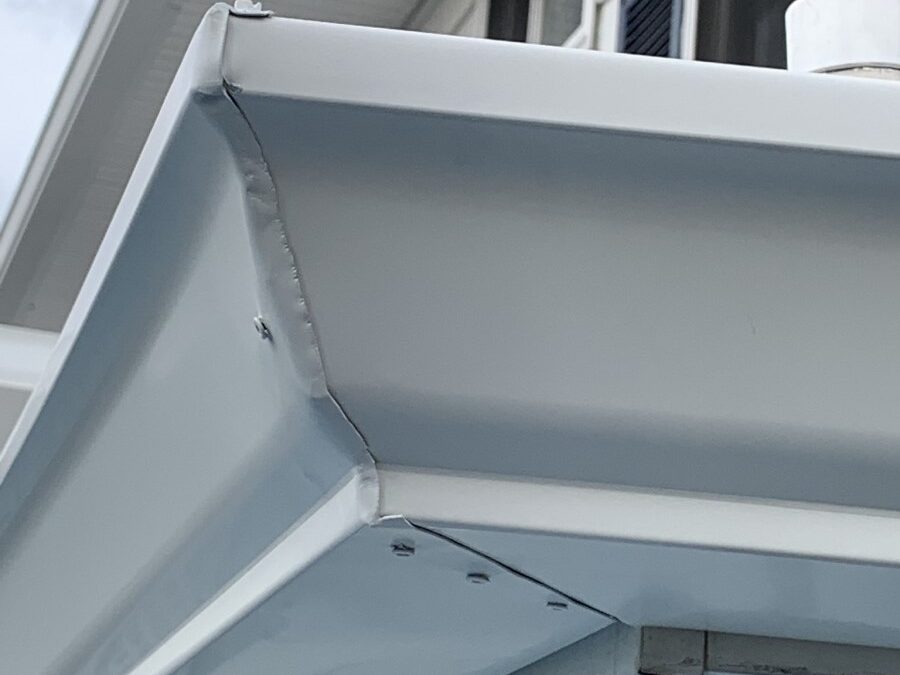
The vast majority of residential gutter installations in the United States use either 5-inch or 6-inch K-style profile gutters. These measurements refer to the width of the gutter’s face — the front-facing dimension of the K-style profile — and they correspond to meaningfully different cross-sectional channel volumes that translate to different drainage capacities.
5-Inch K-Style Gutters: The 5-inch K-style gutter has been the standard residential size for decades and remains the most commonly installed profile in residential construction. Its cross-sectional area supports adequate drainage for moderate roof drainage areas under normal to moderate rainfall intensity conditions. For smaller homes, simple rooflines, and regions with moderate rainfall, 5-inch gutters perform effectively and represent a well-matched sizing choice.
6-Inch K-Style Gutters: The 6-inch K-style gutter provides a meaningfully larger cross-sectional channel area than the 5-inch profile — typically approximately 40 percent more capacity for the same channel length and slope conditions. This additional capacity translates directly to the ability to handle higher inflow rates without overflow — making 6-inch gutters the appropriate choice for larger homes, steeper roofs, complex rooflines with large drainage areas per gutter section, and regions where rainfall intensity regularly produces high peak inflow rates.
For Memphis specifically, the city’s rainfall intensity profile — with summer convective thunderstorms regularly delivering rainfall at rates of one to two inches per hour or higher — creates peak inflow demands that favor 6-inch gutters over 5-inch profiles in many residential applications. A 5-inch gutter that handles normal rainfall adequately may be overwhelmed during Memphis’s most intense summer storm events, producing the overflow conditions that defeat the gutter system’s protective purpose at precisely the moments when that protection is most needed.
Half-Round Gutters: A Third Option for Specific Applications
In addition to K-style profiles, half-round gutters — semicircular channels that were the standard residential profile before K-style gutters became dominant in the mid-twentieth century — are used in specific residential applications, particularly on historic homes and architecturally traditional designs where the half-round profile is more appropriate to the home’s aesthetic character.
Half-round gutters are available in 5-inch and 6-inch sizes (measured as the diameter of the semicircle) and have hydraulic properties slightly different from K-style profiles of equivalent nominal size. The smooth interior curve of the half-round profile creates somewhat lower flow resistance than the flat-bottomed K-style, which partially compensates for the half-round’s somewhat smaller effective cross-sectional area relative to a K-style of the same nominal size. For Memphis homes where half-round gutters are the appropriate aesthetic choice — particularly historic properties in Midtown, Central Gardens, or Cooper-Young — sizing considerations follow the same general principles as K-style sizing, with the hydraulic differences of the half-round profile factored into the assessment.
The Key Factors in Gutter Size Selection
Appropriate gutter sizing for any specific home involves evaluating several factors that interact to determine the peak drainage demand the gutter system must manage.
Roof Drainage Area
The most fundamental sizing factor is the total roof surface area that drains to each gutter section — the square footage of roof surface whose rainfall becomes runoff entering that particular gutter run. Larger drainage areas produce greater total runoff volume per inch of rainfall, requiring greater channel capacity to manage without overflow.
Roof drainage area is not simply the footprint of the home beneath each gutter section. It is the actual sloped surface area of the roof plane above — which is larger than the horizontal footprint by a factor that increases with roof pitch. A steeply pitched roof has meaningfully more surface area than a low-pitched roof of the same plan footprint, and therefore produces more runoff per inch of rainfall. This pitch-area relationship is one reason that steep-roofed homes often benefit from larger gutter profiles than low-pitched homes of similar plan dimensions.
Roof Pitch
Roof pitch affects gutter sizing through two mechanisms. First, as noted above, steeper pitch increases the actual roof surface area relative to the plan footprint, increasing runoff volume. Second, steeper pitch increases the velocity at which runoff reaches the gutter — high-velocity runoff from a steep roof arrives at the gutter channel with more momentum than slow-moving runoff from a shallow pitch, creating higher peak inflow rates that demand greater channel capacity to absorb without overflow.
Memphis’s residential housing stock spans a wide range of roof pitches — from low-sloped ranch and cottage homes to the steep gable and hip roofs of Victorian, Colonial Revival, and Craftsman homes in established neighborhoods. Homes with steep roof pitches in Memphis’s higher-rainfall environment are among the most important candidates for 6-inch gutter profiles because both factors — increased surface area and increased runoff velocity — push peak inflow demands higher than flat-roofed equivalents.
Local Rainfall Intensity
Rainfall intensity — the rate at which rain falls, measured in inches per hour — is the variable that most dramatically amplifies or moderates the drainage demand on gutters in any given region. Two homes with identical roofs in different rainfall regions may require different gutter sizes because the peak inflow rate at the gutters is driven by the local rainfall intensity that produces it.
Memphis’s rainfall intensity profile is among the higher in the mid-South. The city’s Gulf moisture exposure and convective storm activity produce summer thunderstorm events with rainfall rates that regularly exceed one inch per hour and occasionally reach two inches per hour or higher during the most intense cells. These high rainfall intensity events create the peak inflow demands that make gutter sizing particularly consequential in Memphis compared to regions with similar annual rainfall totals but lower peak intensity events.
The widely referenced Rational Method used in stormwater drainage engineering accounts for local rainfall intensity through intensity-duration-frequency (IDF) data specific to each geographic location. For Memphis, the IDF data reflects the high peak intensity events that Memphis’s Gulf-influenced convective storm season produces — data that supports gutter sizing on the more generous end of the capacity range for the home’s roof drainage area and pitch characteristics.
Roofline Complexity and Number of Downspouts
A gutter run’s effective drainage capacity depends not only on the channel size but on how many downspout outlets serve it and how long the run is between outlets. Longer gutter runs with fewer downspouts require more channel capacity at any given cross-section than shorter runs with more frequent downspouts, because the volume of water accumulating in the channel between outlets is greater.
Complex rooflines — multiple gable ends, dormers, varying roof levels, inside corners where two roof planes converge — create individual drainage areas of varying sizes feeding different gutter sections with different flow characteristics. Accurately accounting for the drainage area and flow characteristics of each individual gutter section on a complex roofline is important to appropriate sizing — some sections may be adequately served by 5-inch profiles while others, serving larger or more steeply pitched drainage areas, may require 6-inch profiles for adequate capacity.
Downspout Size and Quantity
Downspouts are the drainage outlet through which gutter channels empty, and their size and quantity are integral to overall system capacity. A 6-inch gutter channel paired with an inadequate number or size of downspouts cannot drain at the capacity the larger channel otherwise provides — the downspout becomes the limiting factor in system drainage capacity.
Standard residential downspout sizes are 2×3-inch (rectangular) and 3×4-inch (rectangular), with round downspouts in 3-inch and 4-inch diameters also used in specific applications. Larger gutter profiles — particularly 6-inch K-style — are typically paired with larger or more numerous downspouts to match the channel’s drainage capacity with adequate outlet capacity. The sizing relationship between channel and downspout is part of the complete system capacity assessment, not a separate consideration.
Memphis-Specific Sizing Recommendations
For Memphis homeowners, several general observations about gutter sizing reflect the city’s specific rainfall environment and housing characteristics:
Larger homes with significant roof area: Homes with total roof surface area above approximately 1,500 to 2,000 square feet, particularly those with moderate to steep roof pitches, are strong candidates for 6-inch gutter profiles throughout, given Memphis’s rainfall intensity and the peak inflow demands that large roof areas generate during intense summer storms.
Steep-pitched roofs of any size: The combination of increased surface area and high runoff velocity from steep pitches in Memphis’s high-intensity rainfall environment makes 6-inch profiles a sensible sizing choice for steeply pitched rooflines regardless of overall home size.
Homes with complex rooflines: Multi-gable, dormer-equipped, and architecturally complex rooflines characteristic of Memphis’s Victorian and Colonial Revival homes in historic neighborhoods should have each gutter section sized based on its individual drainage area — some sections may benefit from 6-inch profiles even if simpler sections of the same home are adequately served by 5-inch profiles.
Single-story ranch homes with low-pitched roofs: The lowest drainage demand scenarios in Memphis residential sizing — small to moderate drainage areas with low pitch and adequate downspout frequency — may be adequately served by 5-inch profiles. However, even in these scenarios Memphis’s rainfall intensity warrants evaluating whether the additional capacity of 6-inch profiles is warranted given the low incremental cost difference between the two sizes.
The Cost of Undersizing vs. the Value of Appropriate Sizing
The consequences of undersized gutters in Memphis’s rainfall environment are the repeated overflow events that deposit concentrated roof surface runoff at the foundation perimeter and against the fascia during the intense summer storms when adequate drainage capacity is most needed. These overflow events and their damage consequences — fascia deterioration, foundation moisture cycling, landscape erosion — represent costs that accumulate over the system’s service life and that appropriate sizing, selected at the time of installation, prevents.
The difference in material between 5-inch and 6-inch gutter profiles represents a modest cost increment relative to the total investment of a gutter installation. Choosing appropriate sizing at installation time is substantially more economical than installing undersized gutters, experiencing the overflow and damage consequences of undersizing through the system’s service life, and ultimately replacing the system with appropriately sized profiles after damage has already occurred.
Conclusion
Choosing the right gutter size for a Memphis, Tennessee home is a decision that directly determines how well the gutter system performs during the intense summer thunderstorms and high annual rainfall that Memphis’s climate delivers. The factors that determine appropriate sizing — roof drainage area, roof pitch, local rainfall intensity, roofline complexity, and downspout configuration — interact to establish the peak drainage demand that the selected gutter profile must handle without overflow. Tiger Gutters recognizes that Memphis homeowners who understand these sizing factors and apply them to their specific home’s characteristics are better equipped to evaluate gutter sizing decisions, understand why appropriate sizing matters in Memphis’s demanding rainfall environment, and ensure that the gutter system protecting their home is matched to the actual drainage demands Memphis’s climate creates.