
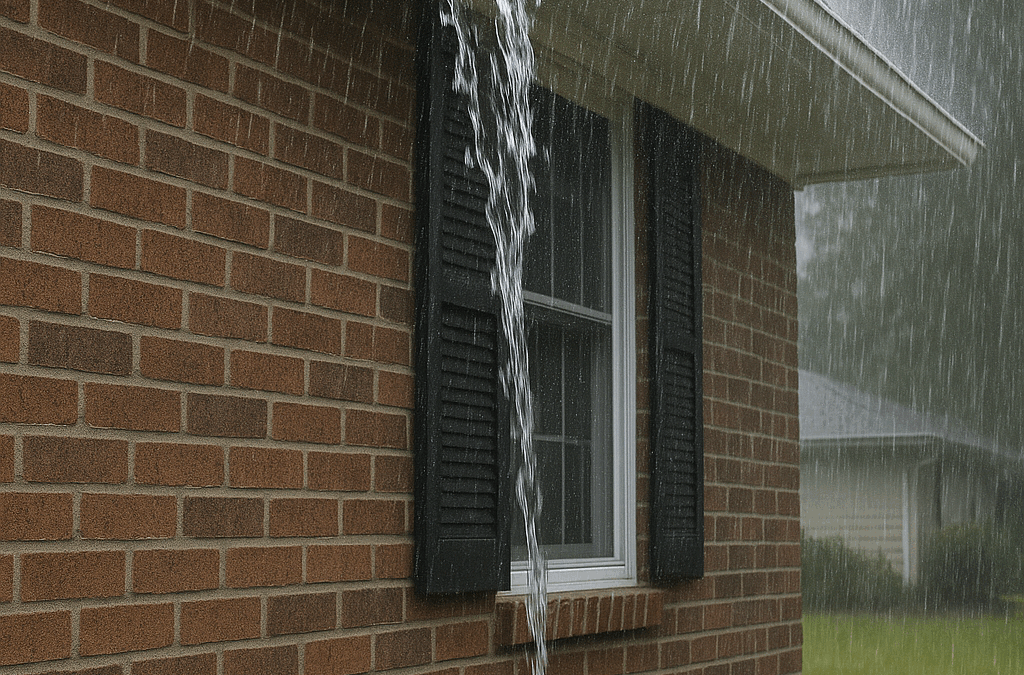
A puddle below a downspout can be confusing. It may appear while the gutter is moving water normally, grow only during a heavy Memphis rain, or remain long after the roof and pavement have dried. Although the downspout marks the place where roof runoff reaches the ground, it is not the only factor that determines whether water collects there.
Rainfall intensity, soil condition, surface slope, debris, and the outlet’s surroundings all affect the pattern. Watching when the puddle starts and how it changes can provide more useful information than its size alone.
A Downspout Concentrates Roof Runoff
Rain landing across a broad roof area is gathered into only a few narrow exit points. The small patch below each downspout may therefore receive a concentrated surge that bears little resemblance to the rain falling directly on the surrounding yard.
This concentration is normal. A puddle can form even when water is traveling through the gutter and downspout without visible backup. The question is what happens after discharge: does the water spread across a sloped surface, soak into the soil, enter a separate drain, or remain in a low area?
The answer may change from one storm to another. A brief shower may soak in quickly, while a longer event can saturate the same soil and leave water at the surface.
Soil Saturation Changes the Result
Dry ground contains spaces that can accept water. As rain continues, those spaces fill and the infiltration rate may slow. A yard that handled an early shower can therefore develop puddles later in the same weather system.
Memphis-area properties do not share identical soil behavior. Plantings, compaction, roots, and prior digging can make neighboring patches absorb runoff differently. A hard surface such as a walkway or driveway behaves differently from a planted bed. Mulch may slow the visible movement of water while compacted soil can shed it toward another low point.
The length of time a puddle remains matters. Water that disappears soon after rainfall reflects a different pattern from water that stays in place through the next day. One observation cannot determine the underlying soil or grading condition, but repeated timing can help describe it.
Surface Slope Directs Water After Discharge
Once water leaves the outlet, gravity follows the local surface. A shallow depression beneath the downspout can hold runoff even if the broader yard appears level. Edging, roots, settled soil, or a raised walkway can also interrupt the route.
Look beyond the point directly below the outlet. A narrow wet trail may show water leaving the puddle toward a lower area. A fan-shaped stain on concrete may reveal how flow spreads during rain. Sediment, displaced mulch, or flattened grass can indicate a repeated surface path, but those signs do not identify how much water moved during any particular storm.
Debris Can Affect Both Ends of the Route
Fall leaves and small twigs may collect inside the gutter or downspout, but they can also gather around the discharge point. Material at the outlet may redirect water sideways or create a temporary barrier. As a result, the wet area may develop to one side of the outlet instead of directly below it.
When debris is removed through gutter and downspout cleaning, the work concerns the roof-drainage channel. It does not change the grade or absorption rate of the surrounding ground, so a clear system can still discharge into an area that puddles.
Upstream restriction usually produces additional clues. Water may spill over the gutter edge, move slowly from the outlet, or appear at a downspout connection. A strong outlet flow paired with a ground-level puddle suggests a different sequence: the roof water is reaching the bottom, but the receiving area is not moving it away as quickly.
Compare Light Rain With a Heavier Storm
Rain intensity can help separate patterns. During a light event, note when water first reaches the outlet and whether it immediately travels away. As rainfall becomes more intense, compare the outlet stream with any water escaping along the roof edge.
Remain in a sheltered, ground-level location. Do not approach moving water during lightning or step onto slick landscaping. A short video from a safe position can capture the order of events for later comparison.
After rain stops, note the puddle’s outline and the time it takes to shrink. Images taken from the same position following different storms may reveal a recurring outline or a pattern that shifts with wind and rain intensity.
Buried Connections Create a Separate Question
Some downspouts empty into an opening or pipe at ground level. That connection may lead to a buried drainage route, but its destination and condition are not visible from the roofline. If moisture rises beside that junction, its cause may differ from water released by an uncovered outlet onto grass.
Avoid assuming where a buried pipe goes or testing it by dismantling connections during wet weather. Its layout may require separate identification. Roof runoff passes from one route into the other, yet the visible guttering and concealed drainage remain distinct parts of the water path.
Reading a Memphis Downspout Puddle in Context
A puddle near a downspout does not automatically show that the gutter has failed. Possible influences include tightly focused roof discharge, soil already holding moisture, a shallow depression, material around the outlet, or an unseen drainage connection. Several of these influences may overlap during a single rain event.
A useful Memphis record pairs the strength of the rain with outlet flow, roof-edge overflow, travel across the surface, and the time the wet area needs to recede. Reviewing each storm this way may indicate the earliest place where the pattern appears: at the roof edge, next to the outlet, or in the yard after discharge.