
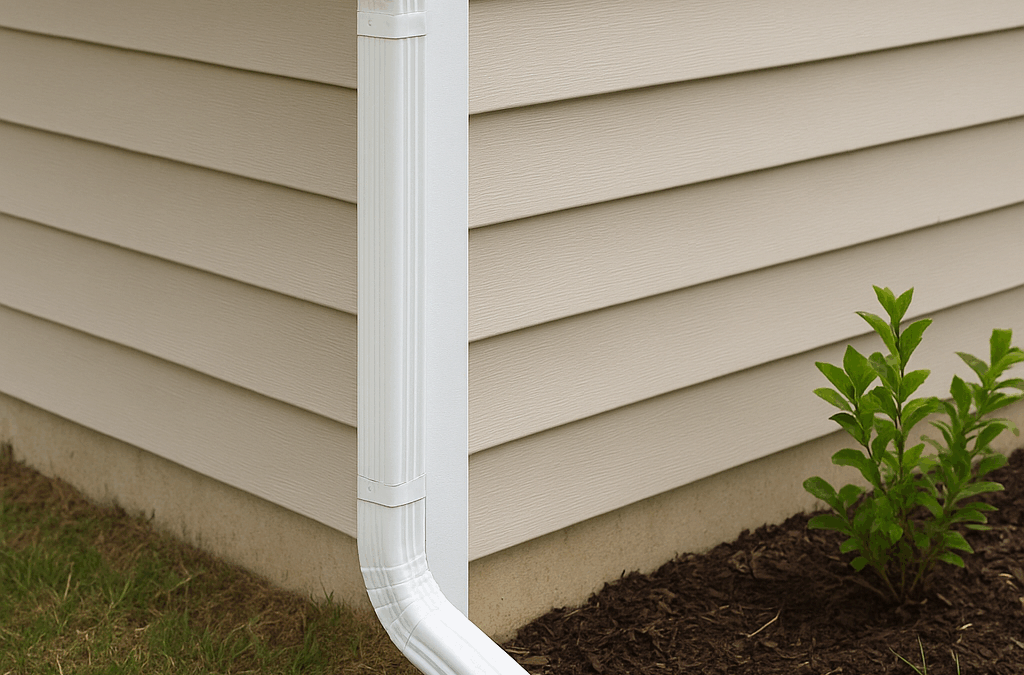
When most homeowners think about their gutter system, they think about the channels along the roofline — the visible components that collect rainfall and carry it toward the downspouts. What receives far less attention, and yet plays an equally critical role in protecting the home from water damage, is what happens after water exits the downspout at ground level. Where that water goes, how far it travels from the foundation, and what path it takes across the landscape determines whether the gutter system’s rainfall collection function actually translates into foundation protection — or whether water collected efficiently at the roof is simply deposited at the worst possible location near the home. Tiger Gutters believes that Memphis, Tennessee homeowners benefit from a thorough understanding of downspout extensions, proper ground-level drainage, and why managing water at the base of every downspout is just as important as managing it at the roofline in Memphis’s demanding rainfall environment.
Why Ground-Level Discharge Management Matters
A gutter system that collects and channels roof surface runoff perfectly — no overflow, no leaking joints, no sagging sections — but deposits that runoff directly at the foundation perimeter has accomplished only half of its intended function. The purpose of a complete gutter system is not merely to move water off the roof. It is to move water away from the home — specifically, away from the foundation, the soil immediately surrounding it, and the below-grade structures that depend on that soil remaining at manageable moisture levels.
When downspouts terminate at ground level without extensions or other discharge management directing water away from the foundation, the entire volume of rainfall collected from the roof surface is deposited in a concentrated stream at the base of the downspout — which is almost always located directly adjacent to the foundation. On a typical Memphis home with 1,500 to 2,500 square feet of roof surface, each inch of rainfall represents hundreds of gallons of water. Without discharge management directing that water away from the foundation, every significant rainfall event deposits that volume at the foundation perimeter in concentrated, high-velocity streams.
In Memphis’s clay-heavy soil environment, this concentrated foundation perimeter discharge creates the repeated soil saturation cycles that drive the shrink-swell soil behavior responsible for the foundation movement, wall cracking, and structural stress that Memphis homeowners encounter more frequently than homeowners in regions with less expansive soils. Managing where downspout discharge goes at ground level is therefore not a cosmetic or minor detail — it is a fundamental component of foundation moisture management in Memphis’s specific geological context.
What Downspout Extensions Are and How They Work
A downspout extension is any device or system that attaches to the bottom of a downspout and directs its discharge away from the foundation perimeter to a safer discharge location. Extensions range from simple and inexpensive to engineered and permanent, and the appropriate choice for any given home depends on the site’s topography, drainage characteristics, landscaping, and the homeowner’s preferences for aesthetics and maintenance.
Rigid Aluminum or Vinyl Extensions: The most common and straightforward downspout extension is a rigid section of aluminum or vinyl — matching or compatible with the downspout material — that attaches to the downspout elbow at grade and extends horizontally away from the foundation before discharging at grade level. These extensions are simple, durable, and effective at moving the discharge point away from the immediate foundation perimeter. A standard extension of four to six feet is commonly recommended as a minimum, though site conditions may call for longer extensions in some Memphis installations — particularly where topography slopes toward the foundation or where planting beds adjacent to the foundation would concentrate discharged water near the home even with standard-length extensions.
Flexible Corrugated Extensions: Corrugated plastic flexible extensions attach to the downspout elbow and can be directed around landscaping features, along foundation edges, or toward a specific discharge target. Their flexibility makes them adaptable to complex site conditions but also makes them prone to being displaced by foot traffic, lawn equipment, and freeze-thaw movement in colder months. In Memphis’s climate, freeze-thaw displacement is a less common concern than in northern cities, but lawn equipment displacement and accidental repositioning are practical considerations for homeowners relying on flexible extensions.
Flip-Up or Hinge Extensions: These hinged rigid extensions lay flat during dry conditions — reducing lawn maintenance interference — and flip to a downward discharge position when water flow from rainfall pushes them open. They provide the functional benefits of a fixed extension during rain events while reducing the ground-level obstruction during dry periods. In Memphis’s climate where summer lawn maintenance is active and frequent, the reduced obstruction profile of flip-up extensions is a practical advantage that many homeowners appreciate.
Underground Drainage Systems: The most permanent and visually unobtrusive discharge management solution connects downspouts to underground drainage pipes that carry water away from the foundation to a remote discharge point — a pop-up emitter in the lawn, a connection to a street drainage system, or discharge at the property perimeter. Underground systems eliminate the above-grade extension hardware entirely, providing a clean appearance while delivering effective long-distance water routing away from the foundation. In Memphis, where high annual rainfall and clay soils make foundation moisture management a priority concern, underground downspout drainage systems are a meaningful foundation protection investment for homeowners with the site conditions and interest to support them.
Rain Barrels and Cisterns: Some Memphis homeowners direct downspout discharge into rain barrels or cisterns for landscape irrigation use — capturing roof runoff for dry-period reuse rather than discharging it to grade. Rain barrels effectively redirect water away from the foundation while providing irrigation water storage, but their capacity is finite — a standard 50-gallon rain barrel fills rapidly during a Memphis storm event and overflows to grade once full. For rain barrel systems to function as genuine foundation moisture management tools rather than merely capturing the first portion of a storm’s discharge, overflow routing from the barrel to an appropriate discharge location away from the foundation is essential.
Splash Blocks: The Minimum Standard
At a minimum, the discharge point of every downspout should be protected by a splash block — a sloped concrete, plastic, or stone form placed beneath the downspout outlet to receive the concentrated stream of downspout discharge and direct it away from the foundation at grade level. Splash blocks protect against the concentrated impact erosion that downspout discharge without protection creates in soil and mulch, and they provide a small degree of directional discharge management.
However, splash blocks alone are not sufficient foundation moisture management for most Memphis homes. A standard splash block extends only 18 to 24 inches from the downspout — not far enough to create meaningful separation between downspout discharge and the foundation perimeter in most installations. Splash blocks are best understood as the minimum acceptable installation at a downspout discharge point, not as a substitute for extensions that actually move discharge water a meaningful distance from the foundation.
How Far Should Water Be Directed Away From the Foundation?
A commonly referenced guideline in residential building and drainage practice is that downspout discharge should be directed a minimum of four to six feet from the foundation before reaching grade. This distance is a general minimum based on typical soil drainage behavior and foundation setback considerations — not an absolute standard that applies uniformly to all sites and conditions.
In Memphis’s clay soil environment, where water absorption rates are slower than in sandy or loamy soils and where the shrink-swell behavior of expansive clays creates foundation movement concerns with repeated saturation, directing discharge farther than the four-to-six-foot minimum is often advantageous. On sites where topography slopes toward the foundation — a common condition in Memphis’s varied residential landscape — extensions long enough to carry discharge past the slope’s convergence toward the foundation may need to be longer than standard to prevent discharged water from draining back toward the foundation after exiting the extension.
The goal in every installation is to achieve discharge at a point where water can percolate into the soil, flow across the surface, or enter a drainage system in a way that does not create concentrated moisture accumulation at or near the foundation perimeter during and after rainfall events.
Site-Specific Drainage Considerations for Memphis Homes
Memphis’s diverse residential topography — from flat lots in suburban developments to sloped lots in the hill neighborhoods of East Memphis and the river bluff areas of the city’s older districts — creates significant site-specific variation in how downspout discharge management should be configured.
Flat Lots: On flat Memphis lots, downspout discharge must be directed away from the foundation by extension length alone, since topographic grade cannot be relied upon to carry water away after discharge. Extensions that discharge onto flat ground adjacent to the foundation may result in water percolating into the soil near the foundation rather than truly moving away from it. On flat lots, longer extensions, underground drainage, or extensions directed toward the street or a graded swale are appropriate to ensure discharge does not accumulate near the foundation.
Sloped Lots — Toward Foundation: On lots that slope toward the home from the street or yard, downspout discharge management must work against the natural drainage direction. Standard extensions discharging to grade on an inward-sloping lot may result in the discharged water draining back toward the foundation along the topographic slope. On these sites, underground drainage systems that carry water past the slope’s low point near the foundation, or very long extensions that discharge at a point where natural topography carries water away, are more effective than standard short extensions.
Sloped Lots — Away From Foundation: On lots that slope away from the home, downspout discharge benefits from natural topographic assistance — water discharged to grade on an outward-sloping lot will tend to continue moving away from the foundation under gravity. Standard extensions are typically adequate on these sites, though ensuring that discharge is truly on the downward slope and not in a topographic depression that could concentrate water near the foundation is still an important installation consideration.
Grading and Landscape Drainage: The Broader Context
Downspout extensions function as part of a broader ground-level drainage system that includes the grading of soil adjacent to the foundation, the drainage behavior of planting beds and landscape features near the home, and the overall site drainage pattern that determines where surface water ultimately flows.
Proper foundation grading — a consistent slope away from the foundation for the first several feet around the home’s perimeter — is the essential complement to downspout extension management. A home with properly extended downspouts but negative foundation grading (grade sloping toward the foundation) will still experience foundation perimeter moisture accumulation from the surface runoff that negative grading concentrates at the foundation line. Conversely, a home with properly graded foundation perimeter areas but inadequately extended downspouts may experience concentrated foundation perimeter moisture at the discharge points even as general surface drainage is adequate.
The most effective ground-level drainage management combines adequate downspout extension discharge distance with proper foundation grading, appropriate landscape bed drainage, and where necessary, supplemental drainage features such as French drains or graded swales that carry surface water efficiently away from the foundation and across or off the property.
Common Downspout Extension Problems Memphis Homeowners Encounter
Missing Extensions: Downspouts terminating at grade level without any extension — discharging directly against the foundation — are among the most common and consequential ground-level drainage deficiencies. This condition is not always original to the home; extensions may have been removed during landscaping work, renovation, or yard cleanup and not replaced.
Displaced or Repositioned Extensions: Flexible extensions and flip-up extensions can be displaced by lawn equipment, foot traffic, or freeze-thaw movement. A displaced extension that has been repositioned to discharge toward the foundation or at an angle that concentrates discharge near the home defeats the extension’s protective function. Regular post-storm and post-lawn maintenance checks of extension position confirm that all extensions remain properly directed.
Blocked Underground Systems: Underground downspout drainage systems can become blocked by root intrusion, sediment accumulation, or collapse over time. A blocked underground system may back up into the downspout and gutter during heavy rainfall, causing overflow at the roof level from a drainage blockage at the underground outlet — an indirect consequence of underground system maintenance neglect that may not be immediately identified as a drainage system blockage.
Inadequate Extension Length: Extensions that technically direct discharge away from the downspout but terminate too close to the foundation — particularly on flat lots or lots with inward topographic slope — may not create sufficient separation between discharge and the foundation to prevent soil saturation near the foundation perimeter during significant Memphis rainfall events.
Seasonal Maintenance Considerations
In Memphis’s climate, downspout extension maintenance considerations are active through most of the year. Summer lawn maintenance season increases the risk of extension displacement by mowing and trimming equipment. Heavy summer storm events should be followed by checks of extension positioning and discharge direction. Autumn leaf fall can block underground system inlets and pop-up emitters, requiring clearing before winter precipitation arrives. Spring pre-storm season checks confirm that the full discharge management system is intact and properly positioned before Memphis’s most active rainfall period begins.
Conclusion
Downspout extensions and proper ground-level water discharge management are essential components of a complete, functional gutter system — components that translate the roof-level water collection that gutters provide into genuine foundation moisture protection for Memphis homes. Without effective discharge management directing downspout water away from the foundation, the most meticulously maintained gutters cannot fulfill their core protective purpose. Tiger Gutters recognizes that Memphis, Tennessee homeowners who understand the importance of downspout discharge management — and who ensure that every downspout on their home directs water an appropriate distance from the foundation through properly installed, maintained, and positioned extensions or underground systems — are protecting their foundations, their landscapes, and their homes more completely than gutter maintenance alone, without ground-level discharge management, can provide in Memphis’s demanding rainfall and clay-soil environment.